In the 3C electronics manufacturing sector, the word "precision" runs through almost the entire process from design to mass production. Products we use frequently every day—such as mobile phones, tablets, earphones, and smart wearable devices—house hundreds and thousands of tiny components, with assembly precision often measured in microns. In this relentless pursuit of perfection where even the slightest deviation matters, a seemingly unassuming yet pivotal component—the high-precision electric cylinder—upholds the quality and efficiency of 3C manufacturing with its precision-driven mission, operating quietly behind the scenes.
The "Precision Mission" of High-Precision Electric Cylinders: Leaping from "Functional" to "Optimal"
Across multiple critical scenarios in 3C manufacturing, high-precision electric cylinders are demonstrating the value of precision through tangible performance:
1. Precision Assembly: Making Micron-Level Errors a Thing of the Past
The assembly of core 3C components (e.g., chips, sensors, micro-motors) often demands pinpoint "point-to-point" fitting.
A mobile phone manufacturer once faced a challenge on its camera module production line: traditional cylinder-driven suction nozzles occasionally shifted when picking and placing 0.4mm-thick optical filters due to unstable air pressure, keeping the yield rate stuck at 92%. After switching to a high-precision electric cylinder solution, real-time position feedback via closed-loop control technology, combined with a repeat positioning accuracy of 0.01mm, made the suction nozzle’s movements as stable as pre-programmed actions, boosting the yield rate directly to 98.5%.
Behind this improvement lies the high-precision electric cylinder’s exceptional fidelity in "translating commands into actions"—much like drawing a circle with a compass: once the center and radius are set, every stroke stays perfectly on track.
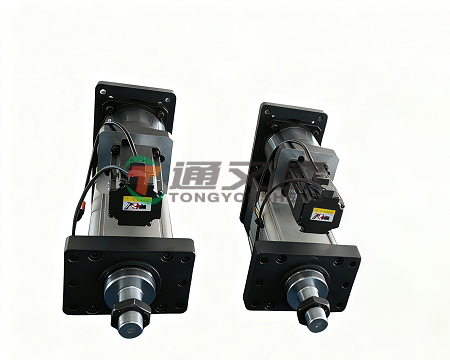
2. Precision Lamination: Dual Assurance of Force and Depth
The lamination of FPC (Flexible Printed Circuit) and PCB (Printed Circuit Board) is an invisible critical step in 3C assembly. Insufficient force leads to poor contact, while excessive force risks damaging the circuits.
After factories introduced high-precision electric cylinders, programming the lamination stroke (e.g., 0.3mm±0.005mm) and pressure curve (e.g., light pre-pressing for positioning followed by uniform pressurization) is equivalent to equipping the lamination process with an "intelligent brake" and a "force scale".
3. Precision Testing: Adding Data Anchors to Quality Assurance
Functional testing of 3C products (e.g., screen touch sensitivity, key rebound force) requires simulating real-world usage scenarios.
Here, high-precision electric cylinders act as "quantifiable human hands"—they can press the screen at a set speed (e.g., 50mm/s) and pressure (e.g., 2N±0.2N), and record feedback data in conjunction with sensors, delivering more consistent and efficient results than manual testing.

Address: Room 601, Building 5, Liandong U Valley, No. 1330 Jinfeng South Road, Mudu Town, Wuzhong District, Suzhou, Jiangsu, China
Suzhou TongYouSheng Electronic Technology Co., Ltd. - An ISO9001 Certified Company All rights reserved. Privacy Policy