Today, as industrial automation advances toward precision and intelligence, force-controlled electric cylinders serve as core actuators, and their force control accuracy directly determines the stability of production processes and the quality of products.
Three Core Approaches to Achieving Precision Control of Force-Controlled Electric Cylinders
Mechanical Structure Optimization: Enhancing Stability from the Source of Power Transmission
The transmission mechanism is the core of power transfer, and its precision directly defines the baseline level of force control. Current mainstream optimization efforts focus on two aspects: lead screw technology and structural design.
In lead screw selection, planetary roller screws leverage their multi-contact load-bearing advantage to reduce wear rate by over 40% compared to traditional ball screws. Combined with preloading processes, they completely eliminate axial backlash, avoiding the impact of return errors on force control accuracy.
In the overall structure of force-controlled electric cylinders, modular design simplifies the power transmission chain, reducing power loss in intermediate links. Meanwhile, the adoption of lightweight materials lowers motion inertia, enabling the force-controlled electric cylinder system to maintain stable force output even during instant start-stop operations.
In addition, upgrades to sealing and lubrication technology cannot be overlooked. For harsh working conditions such as dust and oil contamination, high-protection-class sealing structures effectively extend the service life of transmission components in force-controlled electric cylinders. Adaptive lubrication systems adjust oil supply based on load changes, preventing resistance fluctuations caused by over-lubrication and further enhancing the force control stability of the cylinders.
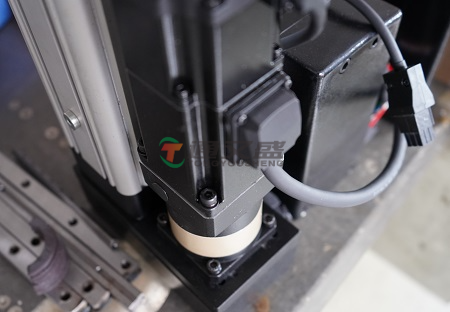
Sensor and Feedback System Upgrades: Precisely Capturing Force Control Signals
Accurate signal acquisition is a prerequisite for force control optimization, and multi-sensor fusion technology has become the industry’s mainstream solution. High-end force-controlled electric cylinders now commonly integrate high-resolution encoders and torque sensors: encoders achieve nanosecond-level position feedback, while torque sensors boast an accuracy of 0.1 N. Combined with current loop feedback, they form a dual-verification mechanism, keeping the force signal acquisition error within ±0.5% FS.
Optimization of signal processing technology further improves data reliability. Denoising algorithms such as wavelet transform boost the signal-to-noise ratio (SNR) of raw sensor data to over 42 dB, effectively filtering out clutter caused by environmental vibrations and electromagnetic interference. In multi-axis coordination scenarios, distributed sensor networks realize synchronous signal transmission via industrial Ethernet, ensuring consistent force output across multiple cylinder movements.
Control Algorithm Innovation: Dynamically Adapting to Complex Working Conditions
If mechanics and sensors are the hardware foundation, then control algorithms are the "brain" behind the force control of electric cylinders. Traditional PID control struggles with parameter tuning and tends to experience accuracy fluctuations when loads change. In contrast, adaptive PID algorithms adjust proportional coefficients in real time to adapt to varying working conditions, enabling force-controlled electric cylinders to maintain a machining accuracy of ±0.01 mm even in scenarios such as grinding wheel wear or sudden load changes.
More advanced pressure-displacement dual closed-loop control technology allows force-controlled electric cylinders to achieve coordinated regulation of force and position. In scenarios such as precision press-fitting, the system first uses position control mode to rapidly approach the workpiece, then automatically switches to force control mode the moment contact is made. It dynamically adjusts the output force through algorithms; when detecting deviations in workpiece thickness, it automatically compensates for stroke to ensure uniform pressure application by the cylinder. This adaptive capability enables force-controlled electric cylinders to handle workpieces of different materials and hardness levels, significantly reducing the risk of overpressure damage or underpressure weak contact.

Address: Room 601, Building 5, Liandong U Valley, No. 1330 Jinfeng South Road, Mudu Town, Wuzhong District, Suzhou, Jiangsu, China
Suzhou TongYouSheng Electronic Technology Co., Ltd. - An ISO9001 Certified Company All rights reserved. Privacy Policy