With the explosive growth of the e-commerce industry and the integrated upgrading of supply chains, logistics equipment is facing four key challenges: **efficiency, precision, cost, and environmental protection**. Traditional pneumatic and hydraulic actuators are gradually becoming inadequate in high-frequency operations, precise control, and low-consumption applications. As a new generation of precision linear actuators, electric thrust cylinders — with their core advantages of high precision, low maintenance, strong adaptability, and energy efficiency — are deeply empowering the entire logistics chain including warehousing, sorting, loading and unloading, and becoming the **efficiency engine** for logistics equipment upgrading.
Guided by the “dual carbon” goals, green and energy-saving development has become a major direction for the upgrading of the logistics industry.
The all-electric drive design of electric thrust cylinders delivers energy conversion efficiency far exceeding that of traditional pneumatic and hydraulic systems. The energy efficiency of pneumatic systems is typically less than 20%, while electric thrust cylinders can reach over 80%. They consume almost no power in standby mode, avoiding energy waste caused by idling air compressors.
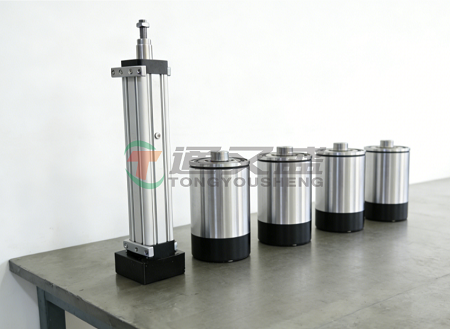
Notably, electric thrust cylinders are inherently intelligent. They can seamlessly connect with PLC and industrial internet platforms to realize remote parameter setting, real-time operation status monitoring, and self-diagnosis of faults.
In intelligent logistics dispatching systems, data such as position, speed, and thrust uploaded by electric thrust cylinders provide an accurate basis for optimizing logistics paths and predictive equipment maintenance, shifting logistics equipment from “passive operation” to “active intelligence”.
For example, by analyzing the operating data of electric thrust cylinders, the system can predict potential equipment failures in advance, transforming maintenance from “emergency repair after breakdown” to “early warning before failure”, further reducing downtime losses.
If you are concerned that electric thrust cylinders are difficult to install and require professional technicians, or if you want to learn about the installation process and precautions, please feel free to contact us. We will provide detailed installation videos and manuals, and can arrange on-site technical guidance if necessary.

Address: Room 601, Building 5, Liandong U Valley, No. 1330 Jinfeng South Road, Mudu Town, Wuzhong District, Suzhou, Jiangsu, China
Suzhou TongYouSheng Electronic Technology Co., Ltd. - An ISO9001 Certified Company All rights reserved. Privacy Policy