A great product starts with great design. The core design philosophy of TYS telescopic electric cylinders is to precisely match application scenarios, rather than blindly pursuing extreme parameters. Work at this stage directly determines whether the product can perform stably under actual working conditions.
1. Demand Conversion: Translate Customer Pain Points into Technical Parameters
The first step in designing a telescopic electric cylinder is not drawing, but in-depth communication.
Our technical team focuses on customers’ core demands and extracts key parameters:thrust, operating speed, stroke length, positioning accuracy, repeat positioning accuracy, duty cycle, installation method, and operating environment (such as high/low temperature, dusty, or corrosive conditions).
These parameters act like the “genetic code” of the telescopic electric cylinder, and all subsequent calculations are based on them.
For example:
The semiconductor industry requires compact micro telescopic electric cylinders with high repeat positioning accuracy.
For heavy-duty handling applications, emphasis is placed on thrust and rigidity design.
2. Core Calculation: Let Every Component Fulfill Its Function
The essence of telescopic electric cylinder design is the art of balance, unifying performance and reliability through rigorous calculations.
Motor Selection
The motor is the “heart” of the telescopic electric cylinder.Torque is calculated based on thrust (F), screw lead (t), and transmission efficiency (η):Motor selection: The motor is the "heart" of the telescopic electric cylinder. The required torque shall be calculated based on thrust (F), screw lead (t) and transmission efficiency (η):T = (F × t) / (2π × η)
Combined with load inertia, acceleration/deceleration requirements, and a safety factor of 1.5–2 times, we determine the final motor power and speed.
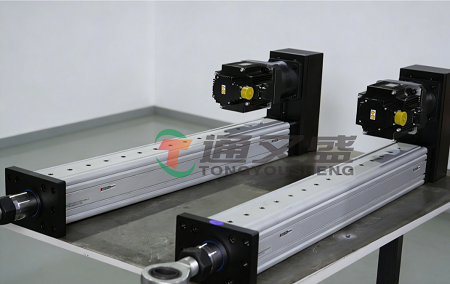
The screw is the “backbone” of power transmission.
Ball screw: for high efficiency and high speed.
Planetary roller screw: for heavy load and high rigidity.
We strictly check equivalent load, rated life, strut stability, and critical speed to avoid instability or resonance during operation.
Structural Optimization
Using CAD/CAE software for 3D modeling and finite element analysis, we balance rigidity and lightweight design, optimize bearing seat layout, anti-rotation mechanism, and heat dissipation to avoid stress concentration and deformation in advance.
For special environments:
High temperature: polyimide insulation materials
Low temperature: cold-resistant aluminum alloy
Corrosive environment: 316L stainless steel components
3. System Matching: Break the Misconception that “Excellent Parts = Excellent Machine”
High-quality telescopic electric cylinders pursue system synergy, not just extreme performance of individual parts.
For example:
Matching precision-ground screws above C3 class with SP-class linear guides.
Pre?stretching to compensate for thermal elongation, achieving a “1+1>2” precision effect.
The screw support seat and guide mounting surface are machined in one setup to ensure unified datum and improved system rigidity.This design ensures stable accuracy at high speeds and extended service life under heavy loads.
If you want to compare the performance of telescopic electric cylinders with different strokes and speeds, or are unsure how to select models based on project requirements, welcome to contact us.We will recommend suitable telescopic electric cylinder models through demand analysis for your comparison and selection.

Address: Room 601, Building 5, Liandong U Valley, No. 1330 Jinfeng South Road, Mudu Town, Wuzhong District, Suzhou, Jiangsu, China
Suzhou TongYouSheng Electronic Technology Co., Ltd. - An ISO9001 Certified Company All rights reserved. Privacy Policy