


In the aerospace field, reliability and precision often equate to safety and success. Whether it is the ground testing of aircraft, the deployment mechanisms of satellite antennas, or the attitude adjustment of airborne equipment, a drive solution that can withstand harsh environments and maintain precise control is essential. Self-locking electric cylinders—devices that convert the rotational motion of a motor into linear push-pull movement—are emerging as a trustworthy partner in aerospace engineering by virtue of their inherent advantages.
The "Aerospace DNA" of Self-Locking Electric Cylinders
1. Precisely Controllable with Predictable Movements
Through closed-loop control and high-resolution position feedback, self-locking electric cylinders translate commands into stable, repeatable linear motion. In scenarios such as satellite antenna deployment, optical instrument focusing, and hatch locking, they execute movements in accordance with pre-set trajectories and speeds, reducing uncertainties caused by manual operation or pressure fluctuations.
2. Compact Structure to Alleviate Payload Burden
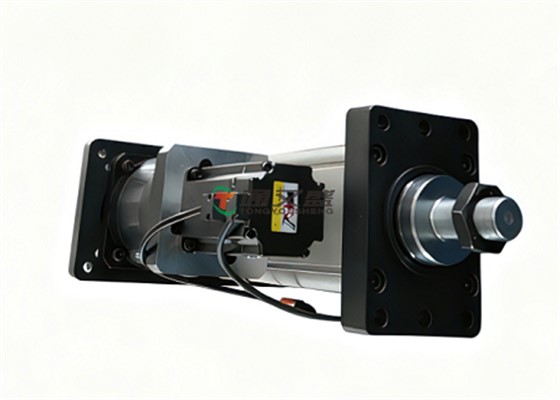
Unlike hydraulic systems that require pumps, pipelines and oil tanks, self-locking electric cylinders eliminate a large number of auxiliary components, featuring more controllable volume and weight. They are easy to arrange within limited space and payload budgets, which is particularly crucial for weight reduction of aircraft.
3. Clean and Low-Noise for Special Environments
Self-locking electric cylinders pose no risk of oil leakage and generate no exhaust pulsation, offering distinct advantages in vacuum chambers, clean rooms or enclosed equipment. They meet the aerospace industry’s requirements for cleanliness and low disturbance.
4. Easy Integration and Programming
Programmable via a controller, self-locking electric cylinders can pre-set a variety of motion profiles (e.g., soft start/stop, segmented variable speed) and link with sensors and flight control systems to achieve complex multi-step motion sequences, making ground tests or space missions more flexible.
Typical Application Scenarios of Self-Locking Electric Cylinders
Ground Test Benches: In aircraft landing gear fatigue tests and structural load tests, self-locking electric cylinders simulate cyclic loads and precisely control displacement and pressure curves, helping engineers obtain reliable test data.
Satellite Mechanisms: The deployment devices for antennas or solar panels of small satellites are driven by self-locking electric cylinders to achieve accurate on-orbit positioning and locking.
Airborne Equipment Adjustment: For fine-tuning mechanisms such as optical targeting and infrared detection platforms, self-locking electric cylinders maintain stable pointing in vibrating environments, improving the accuracy of observation and measurement.
Hatch and Locking Mechanisms: In manned spacecraft or high-altitude test platforms, self-locking electric cylinders are used for hatch opening/closing and sealed locking, ensuring a smooth process and reliable positioning.