The realization of multi-cylinder synchronous control for linear electric cylinders relies on the coordinated operation of a series of advanced technologies, among which the closed-loop feedback system and dynamic adjustment technology play a core role.
The closed-loop feedback system is like the "nervous system" of multi-cylinder synchronous control for linear electric cylinders, responsible for real-time sensing and transmission of key information.
Each linear electric cylinder is equipped with high-precision sensors, such as displacement sensors and force sensors.
Displacement sensors can accurately monitor the position changes of the piston rods of linear electric cylinders, convert them into electrical signals and feed them back to the control system; force sensors can real-time detect the output force of linear electric cylinders and transmit the data to the control system as well.
These sensors are just like the "eyes" and "antennae" of linear electric cylinders, capturing the motion states of the cylinders at all times.
After receiving the signals fed back by the sensors, the control system will compare and analyze them with the preset target values.
For example, in an application scenario where multiple linear electric cylinders are required to lift a heavy object simultaneously, each cylinder is set to lift the heavy object to the same height.
When the displacement sensor of a certain linear electric cylinder feeds back a deviation between the rising height of its piston rod and the set value, the control system will respond quickly.
Dynamic adjustment technology is the key means to execute this adjustment command. It mainly realizes the adjustment of motion parameters by controlling the drive motors of linear electric cylinders.
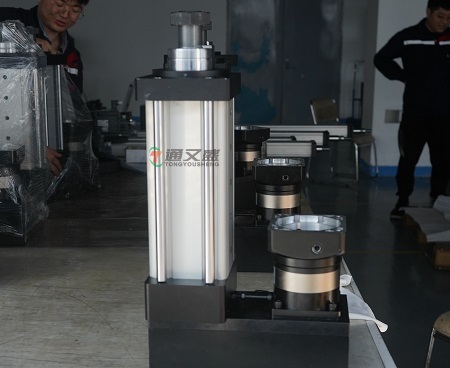
Taking the commonly used linear electric cylinders driven by servo motors as an example, based on the deviation information fed back by the sensors, the control system uses advanced control algorithms to calculate the adjustment amount required for the current, voltage or pulse signals output by the motors. Then, by changing the motor's speed, rotation direction and other parameters, it accurately adjusts the movement speed and displacement of the linear electric cylinders, making the motion states of each cylinder gradually approach the set synchronous target.
This dynamic adjustment is carried out in real time and continuously, which can timely compensate for the motion deviations caused by various factors (such as load differences, friction changes, inconsistent motor characteristics, etc.), ensuring that multiple linear electric cylinders always maintain a high degree of synchronization.
In addition, communication technology also plays an important role in the multi-cylinder synchronous control of linear electric cylinders.
A high-speed and stable communication network serves as a bridge for the rapid transmission and sharing of information among all linear electric cylinders. For instance, communication protocols such as EtherCAT and CAN can transmit the instructions of the control system to the controllers of each linear electric cylinder with extreme speed and accuracy, and at the same time, feed back the real-time status information of each cylinder to the control system promptly.
This efficient communication ensures the timeliness and accuracy of multi-cylinder synchronous control for linear electric cylinders, avoids synchronization errors caused by information transmission delays, and enables the entire multi-cylinder system of linear electric cylinders to complete various complex tasks in a coordinated and consistent manner like a closely cooperating team.